Rooftop Solar in Hill Stations: Performance in Monsoons, Winter Fog, and High-Wind Terrains
Installing rooftop solar in a plains city like Delhi or Bareilly is straightforward. You get flat concrete roofs, predictable sun angles, and standard mounting structures.
Hills are different. If you live or run a business in Nainital, Mussoorie, Almora, or Ranikhet, your property faces heavy monsoon rain, thick winter fog, high-velocity squalls, and steep roof slopes.
A common doubt property owners in Kumaon and Garhwal have is whether solar panels actually generate enough power under these mountain weather conditions to justify the setup cost.
The short answer is yes—if you design the system for mountain geography rather than copying a flat-land blueprint. Here is how solar arrays perform across mountain weather cycles and the exact engineering choices required to keep them running for 25 years.
1. Monsoon Performance: Cloud Cover and Heavy Rain
Between late June and September, hill stations across Uttarakhand receive heavy rainfall and prolonged overcast weather.
Do Panels Generate Power When It Rains?
Solar panels do not need direct, blinding sunlight to generate electricity. They run on light irradiance.
- Direct Sunlight: Yields 100% rated generation capacity.
- Thick Monsoonal Clouds: Yields 15% to 30% of rated capacity using diffuse light.
During monsoon months, a 5 kW array that produces 22 units on a clear May day will drop to around 6 to 8 units on a dark, rainy July afternoon. Over a full year, higher generation during sunny spring and autumn months offsets monsoon dips. Annual generation models for Kumaon and Garhwal factor in 60 to 75 low-yield weather days automatically.
The Rain Cleaning Effect
Heavy rainfall cleans panel surfaces naturally. In lower plains cities, dust accumulation reduces panel efficiency by 8% to 12% if panels are not washed regularly. In hill regions, monsoon downpours wash away accumulated dust, pollen, and pine needle resin, restoring glass transparency without manual labor.
2. Winter Fog, Frost, and Low Sun Angles
Winter brings two distinct weather patterns across Uttarakhand: heavy ground fog in valley towns (like Haldwani and Ramnagar) and freezing cold with high solar clarity in ridge stations (like Mukteshwar and Auli).
Valley Fog vs. High-Altitude Sun
Valley fog blocks direct sunlight until mid-day. A solar array in a foggy valley lose morning generation hours between December and January.
Higher hill ridges sit above the fog line. Because solar photovoltaic cells run more efficiently at low ambient temperatures, a clear, cold January day in Almora often yields higher peak voltage output than a hot 42°C June day in the plains. High heat causes panel voltage degradation; cold temperatures boost cell conversion efficiency.
Panel Technology Choice: Mono-PERC vs. TOPCon
For hill installations, cell selection matters:
- Older Polycrystalline Panels: Weak low-light performance. Generation drops severely during overcast or foggy hours.
- N-Type TOPCon Panels: Higher bifacial and low-light efficiency. They capture broader light spectrums early in the morning and during fog, making them the standard choice for hill terrains.
3. High-Wind Terrains and Structural Anchoring
Ridge lines and open mountain valleys experience severe pre-monsoon wind squalls. Wind speeds in locations like Lansdowne or Ranikhet routinely cross 100 to 120 km/h.
If an installer uses standard lightweight aluminum frames meant for sheltered urban roofs, mountain winds can tear panels off their mountings or bend frame legs.
Essential Structural Requirements for Hill Roofs:
- Hot-Dip Galvanized Steel Mounts: Frames must feature a minimum 80-micron hot-dip zinc coating to prevent rust caused by high mountain humidity and rain.
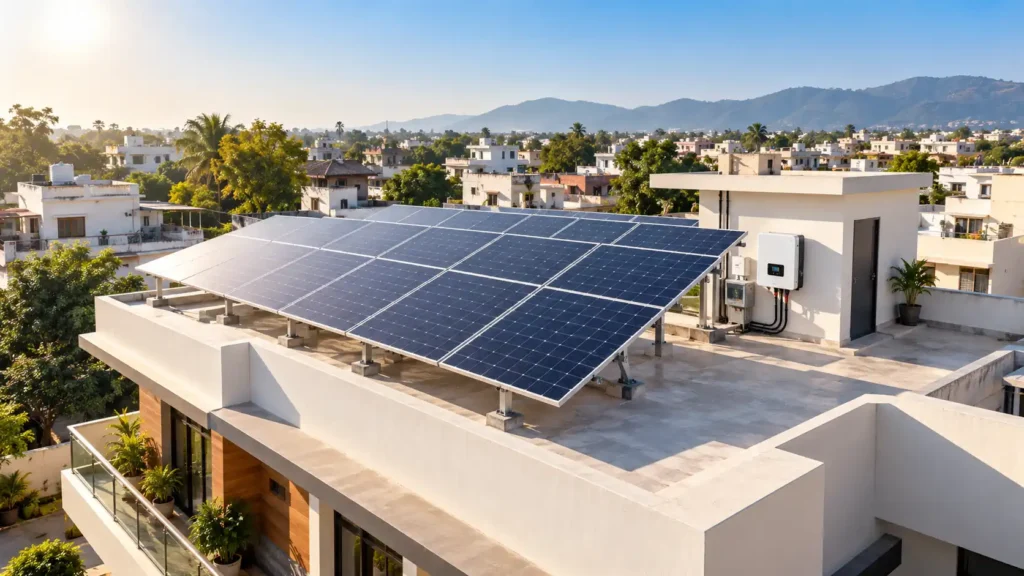
- Chemical Anchor Fastening: Leg bases cannot rely on simple expansion fasteners dropped into top plaster. Mounting plates must be anchored directly into concrete structural beams using chemical grout fasteners.
- Rear Strut Bracing: Wind blowing up mountain slopes creates high uplift force under tilted panels. Adding rear diagonal cross-bracing stops frame twisting.
4. Sloped Tin Roofs and Structural Leak Prevention
Many residential homes, heritage bungalows, and resorts in hill stations feature sloped sheet roofs (GI sheets, corrugated tin, or shingles) rather than flat RCC slabs.
Installing solar on sloped roofs requires non-destructive mounting hardware:
- Short-Rail Mounting: Anodized aluminum short rails are fastened directly onto the raised ribs of corrugated sheets using EPDM rubber-gasket self-drilling screws. This ensures a watertight seal that prevents rainwater from seeping through screw holes into ceilings below.
- Slope Alignment: Sloped roofs often have built-in pitch. If your roof tilts south or south-west, panels mount flush against the roof structure, reducing wind resistance while maintaining optimal tilt angles.
5. Grid Instability and Inverter Selection in Remote Hills
Grid power in remote hill pockets often suffers from wide voltage fluctuations, phase imbalances, and prolonged line outages caused by fallen tree branches on distribution lines.
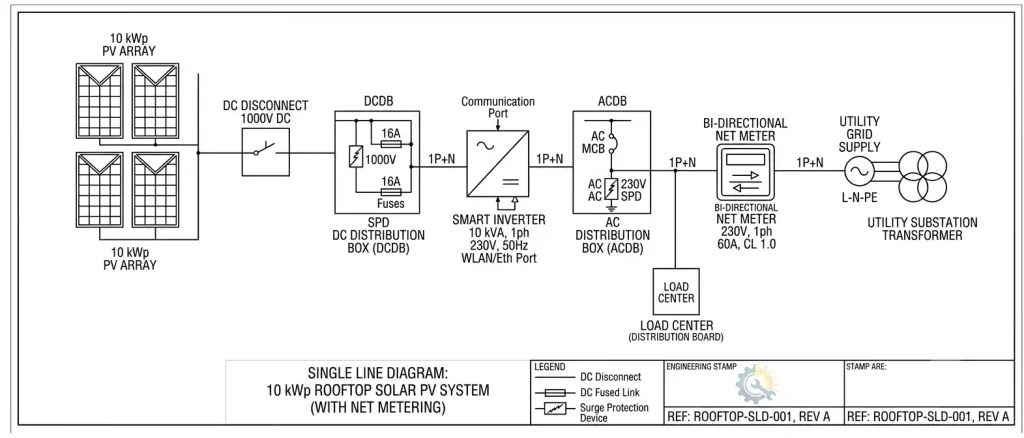
An on-grid solar plant requires an active grid signal to operate. If UPCL power cuts out, a standard on-grid system turns off immediately.
Selecting the Right Inverter Setup for Mountain Properties:
- For Urban Hill Towns (Dehradun, Haldwani, Solan): Standard On-Grid Inverters with wide input voltage tolerance (120V–1000V) handle minor grid voltage fluctuations without tripping.
- For Remote Resorts and Hill Homes: Hybrid Inverters with Lithium Battery Storage are necessary. When the UPCL grid drops, the hybrid inverter disconnects from the grid within 10 milliseconds and powers critical loads (lights, Wi-Fi, water pumps, refrigeration) using stored solar power.
Practical Checklist Before Solar Installation in the Hills
Before signing an installation contract for a hill property, verify these technical parameters:
- Rooftop Shadow Mapping: Check for surrounding pine trees, mountain ridges, or adjacent structures that block southern exposure between 10:00 AM and 3:00 PM.
- DISCOM Transformer Limit: Confirm that your local UPCL 11kV transformer has available capacity for net-metering approvals.
- Mounting Structural Rating: Ensure your installer provides structural calculations confirming wind resistance up to at least 150 km/h.
- Local Service Support: Verify that your installer has field engineers stationed in your district (e.g., Nainital, Dehradun, or Almora) so maintenance teams can reach your site within 24–48 hours if an inverter trips.